
The Translucent Quartz
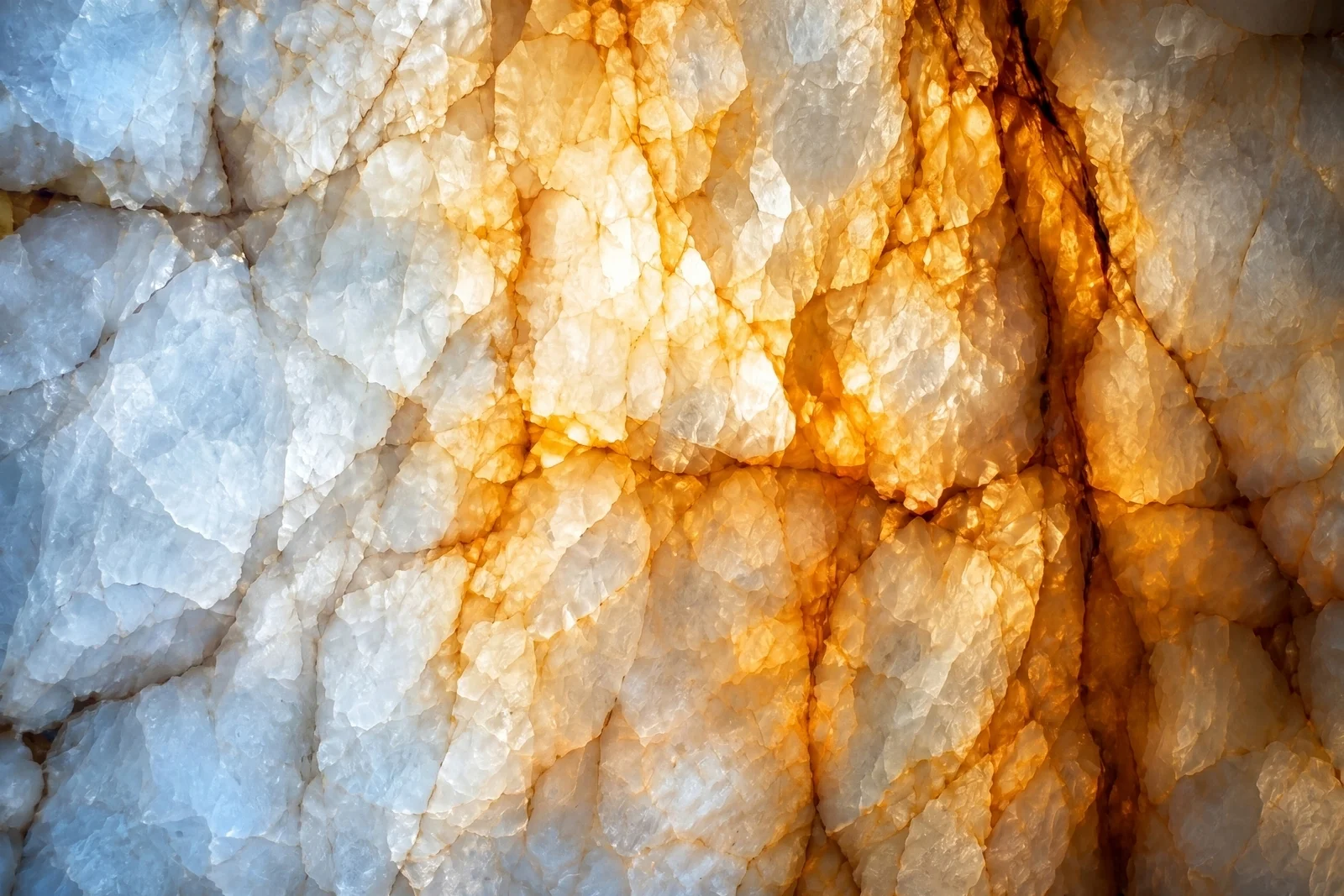
Cristallo is the natural quartz that doesn't behave like stone. It accepts light, holds it, and lets it through. A Material Study from AGL Surfaces.
In this editorial
A study in geology that holds light: the natural stone that taught architectural lighting what it could be.
What you’re looking at when you specify Cristallo is twenty million years of compressed silica, held in suspension. The light just makes it visible.
Moreno Ruaro — Technical Advisor, AGL Surfaces
There is a class of natural stone that does not behave like stone. It accepts light, holds it, lets it through. It reads as dark when shadowed and as fire when illuminated from behind. The geological term for what it does is translucence. The architectural term, at least in our portfolio, is Cristallo.
If you read our first editorial, you already saw it: the fragmented portrait behind the geometric lattice in Section III, the slab that turned cool, then warm, then disappeared back into the ambient stone. That was Cristallo. This study is what was happening inside the slab.
Origin
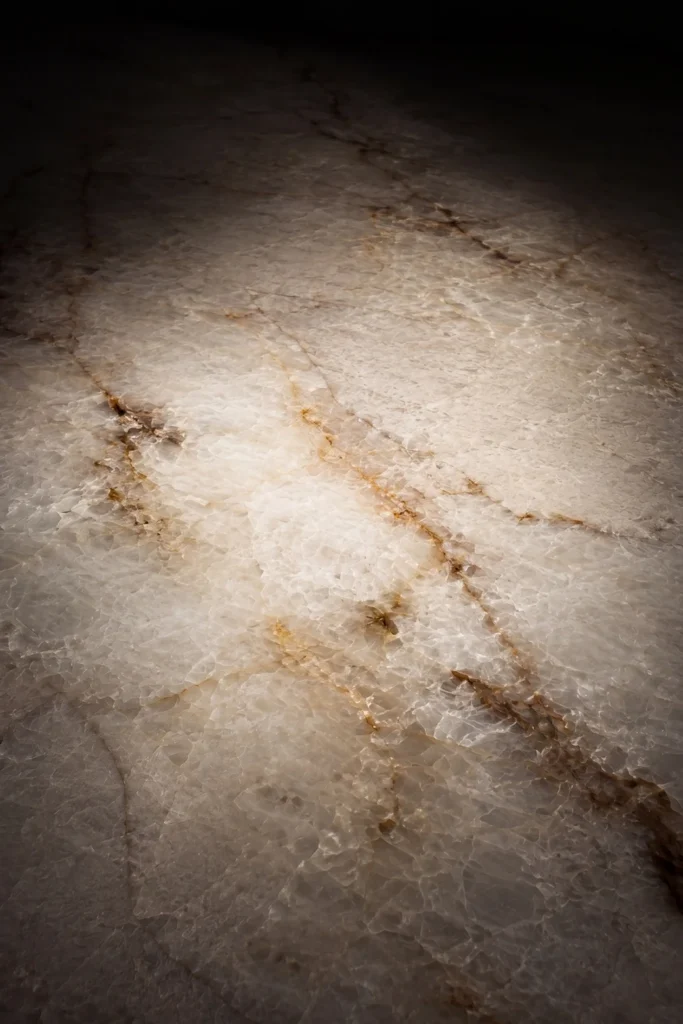
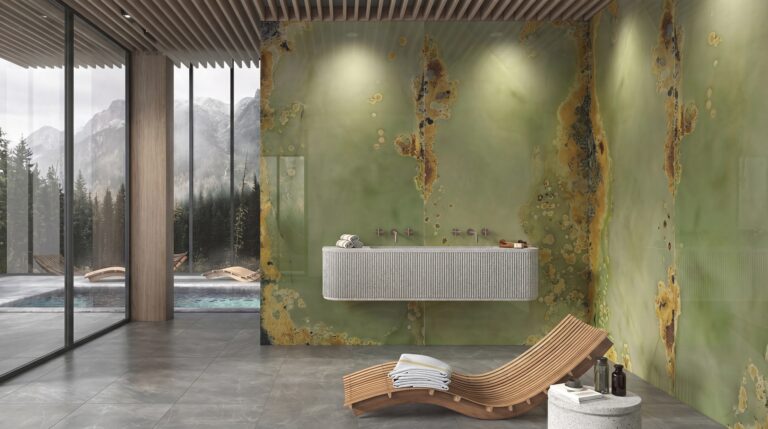
Cristallo forms within the earth’s deep mineral layers. Crystalline silica, compressed and heated over millions of years, settles into a structure dense enough to behave like stone and clear enough to behave like glass. The seams of brown and amber that run through it are not decorative patterns. They are the geological record of the pressure that produced it.
It is not engineered. It is not poured. It is quarried. Every slab carries the unrepeatable mineral signature of where it formed, a fact that matters more than it sounds. Two adjacent Cristallo slabs from the same quarry will read as siblings rather than duplicates. The architectural language is natural variation. The reality is that geology refuses to repeat itself.
What separates Cristallo from other natural quartzes is how light interacts within it. Most stone stops light at the surface. Cristallo lets it travel. The crystalline lattice, the same structure that gives raw quartz its prismatic break, diffuses light through the body of the slab before releasing it back to the eye. The result is depth that reads as luminous rather than reflected.
Behavior
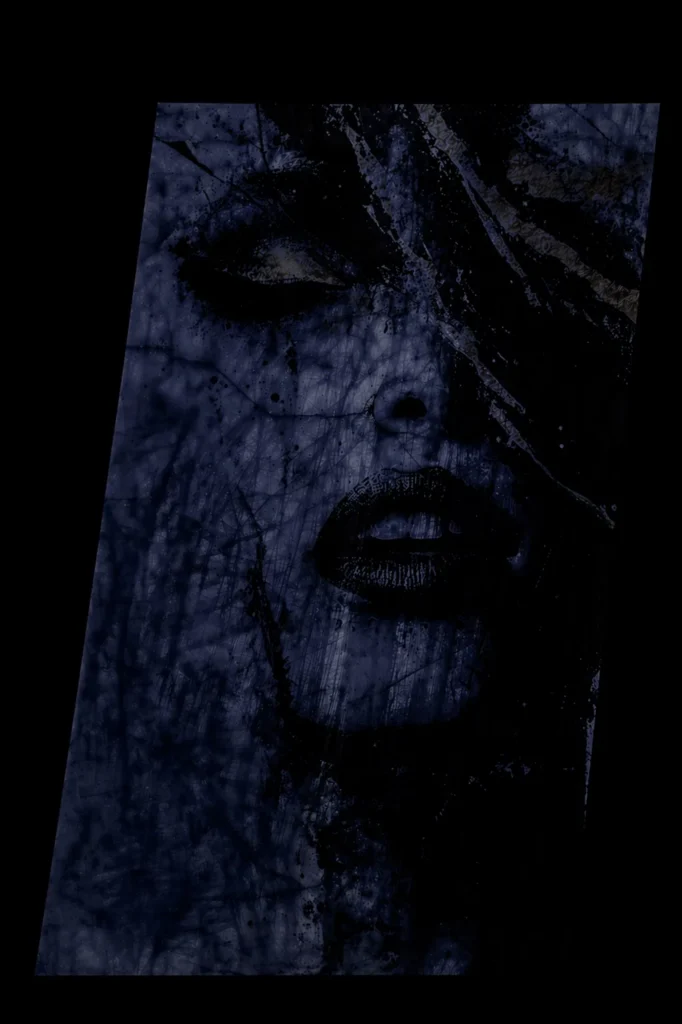
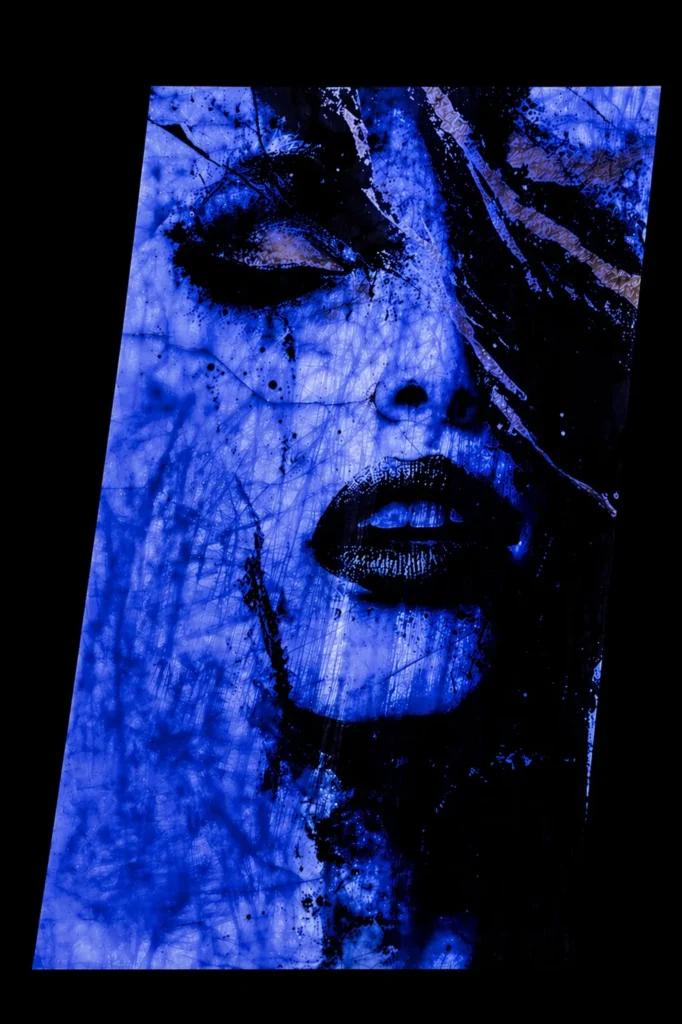
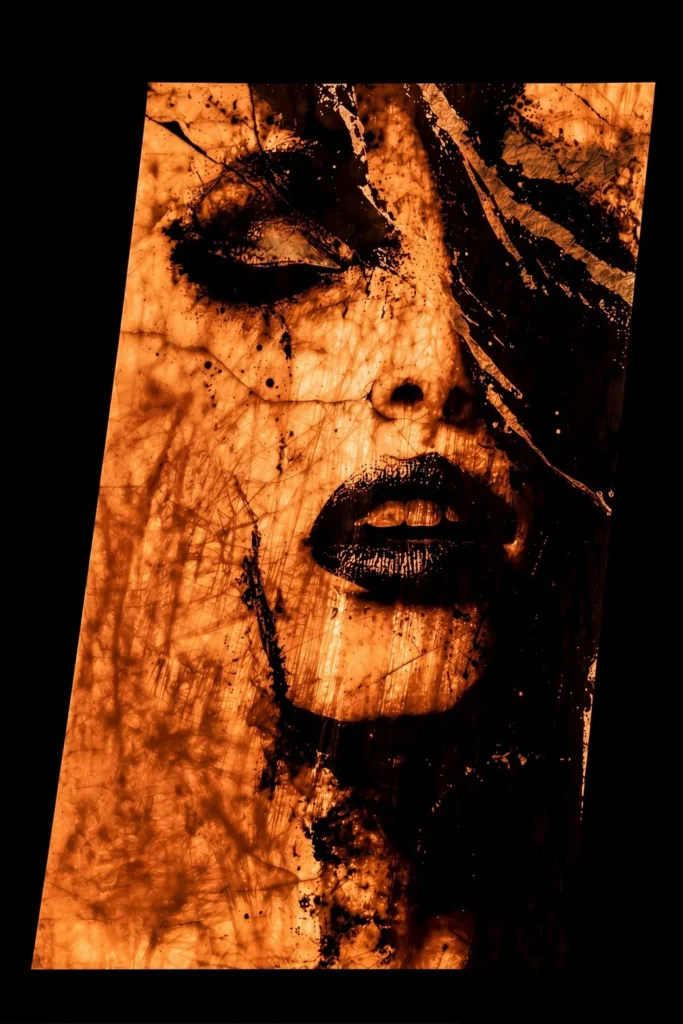
What you do with Cristallo depends on how you light it.
In ambient light, the slab reads as a quiet mineral surface: variegated, dimensional, calm. Brown and amber veins suggest geology without announcing it. The portrait behind the Galleria fireplace, in this state, is something you almost miss. The stone is in repose.
Apply cool LED illumination from behind, and the structure inverts. The crystalline matrix turns the entire slab into a backlit window. The image trapped inside becomes a portrait again. The room feels like a gallery.
Switch to warm amber, and the same slab becomes intimate. The architecture of the room changes without the architecture moving.
This is the property that has made Cristallo the material of choice for environments where light is a design element. Think fireplaces, spa surrounds, hospitality bars, retail thresholds. The transformation isn’t an effect. It’s the material doing what it does when you ask it the right question.
Process
Cristallo arrives at the fabricator as a raw slab. It’s heavy and dense, with a mineral surface produced by millennia of compression. From there, the work depends on what the architect has specified.
For most architectural applications, the surface is honed or polished to one of several finishes. Backlighting asks nothing special of the surface. Cristallo’s translucency is native to the stone, so a standard honed or polished finish carries light without any added glass-ceramic treatment. What changes the behaviour is the lighting behind a properly supported slab, not the surface on top of it.
Fabrication, for Cristallo, is the discipline of preserving what the material already is while releasing what it can do.
Application
Where Cristallo thrives, in architecture, is anywhere light is part of the program.
A residential fireplace becomes the most natural application. The fireplace was already the room’s light source; Cristallo doesn’t fight that, in fact, it joins it. Lit by the fire and supplemented by integrated LED, the slab cycles through states throughout the day. Quiet in the morning. Active at night. The fireplace is no longer a feature; it is the room’s clock.
In a hospitality bar, Cristallo behaves as theatre. Backlit, it casts the bar in a luminous register that no overhead fixture can replicate (the light feels like it’s coming from the bar, because it is). Bottles set on the surface read as silhouettes against an internal glow. Even the drink becomes part of the architecture.
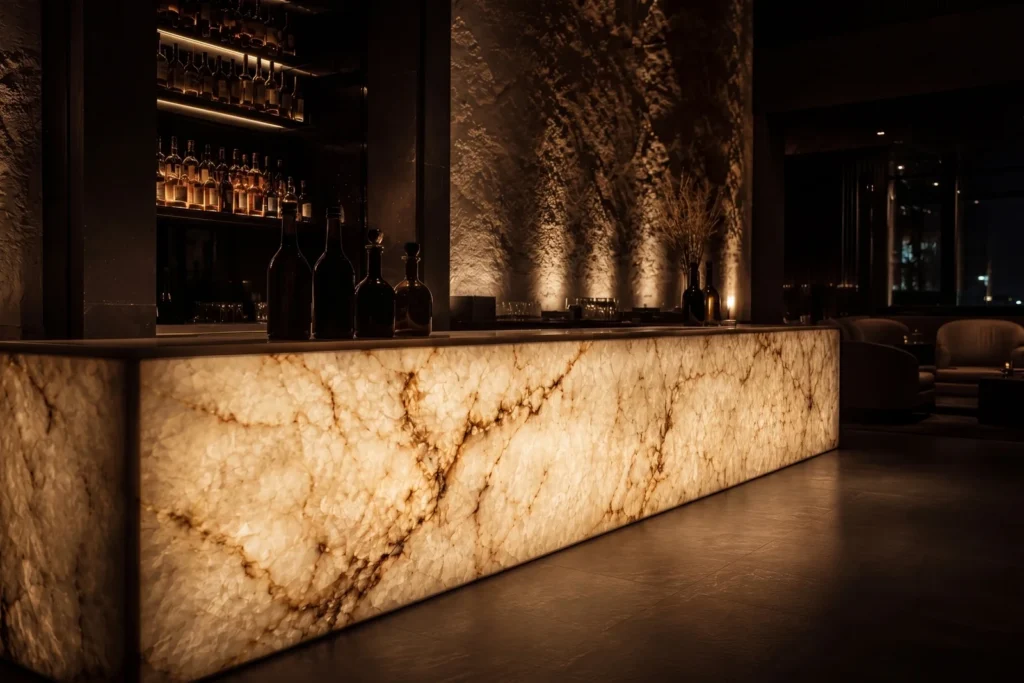
In residential bathrooms, Cristallo holds a different function. A vanity face or basin formed from a single slab introduces a quality of light that softens the entire room without requiring additional fixtures. The stone replaces the ambient lighting strategy.
In retail and hospitality, Cristallo partition walls turn rooms into rooms within rooms. The translucency suggests separation without enforcing it. Visitors can sense what’s beyond before they enter it. The wall is permeable to the atmosphere even when impermeable to traffic.
The pattern, across these applications, is consistent. Cristallo replaces decorative lighting with material lighting. It is the answer to ‘how do we make this space feel a certain way?’ without resorting to fixtures or theatrics.
Specification
For designers and fabricators considering Cristallo, a few principles hold.
Specify Cristallo where light is already a design element, such as fireplaces, bars, feature walls, and thresholds. Specify it where the room rewards a slow read. Avoid it on heavy horizontal work surfaces where translucency goes unused, and the stone is asked to function solely as a countertop. There are better materials for that.
Ask the fabricator about LED compatibility. Cristallo’s translucency is uniform but not infinite. Heat dissipation, panel spacing, and dimming infrastructure all affect the long-term consistency of the surface. The best installations design the lighting and the slab together. They are not separate trades.
Order the full slab photograph before specifying. Two Cristallo slabs are never identical, and the veining you see in a sample is not the veining you will receive. This is the cost of geological authenticity.
Plan for the maintenance the stone deserves. Like all natural quartz, Cristallo is resistant but not invulnerable. Acidic cleaners are not its friends. A pH-neutral cleaner and a soft cloth will keep the surface in the state that the geology spent millions of years producing.
In closing
The materials that age well in architecture are the ones that respect light. Cristallo respects light by becoming a function of it. There is no inert state. The stone is always in conversation with what’s around it.
This is what the first editorial began describing: the way material behaviour is itself a kind of architecture. Cristallo is the clearest demonstration we have. Subtle when it should be subtle. Luminous when the room asks it to be. Always present, but never insistent.
That is what translucent quartz looks like when you treat it as architecture.
We don’t sell Cristallo. We help architects understand what it does, and then we make sure they specify it in the right places.
Ivan Couto — President, AGL Surfaces
Continue reading.
All editorials →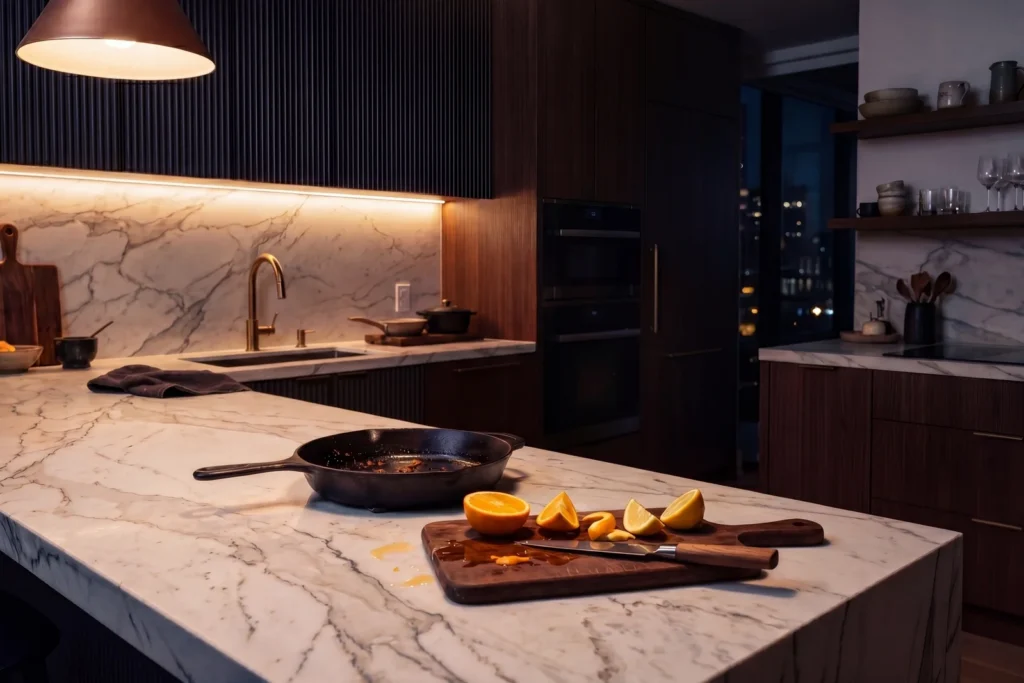 Material Intelligence · 6 min
Sintered Stone vs. Quartz
Sintered stone vs. quartz u2014 a composition-level comparison covering heat, UV, outdoor performance, stain resistance, maintenance, and when to specify each.
Material Intelligence · 6 min
Sintered Stone vs. Quartz
Sintered stone vs. quartz u2014 a composition-level comparison covering heat, UV, outdoor performance, stain resistance, maintenance, and when to specify each.
 Galleria Editorial · 7 min
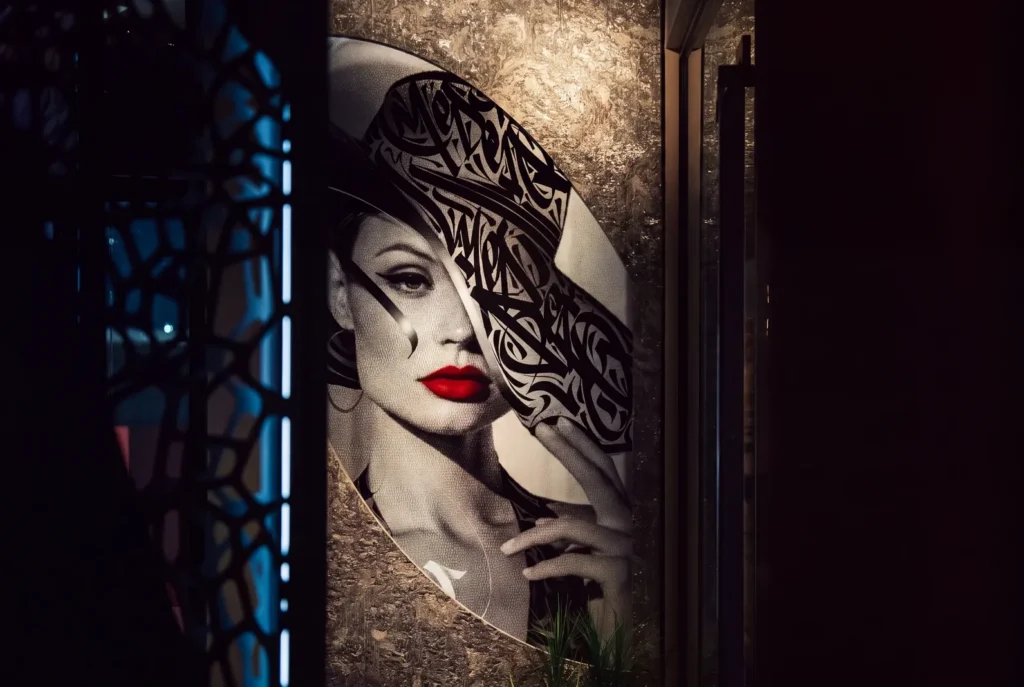
The Anatomy of Light & Surface
A study in seven installations from inside the AGL Galleria: how light, shadow, and craft turn natural stone, sintered surfaces, and metalwork…
Galleria Editorial · 7 min
The Anatomy of Light & Surface
A study in seven installations from inside the AGL Galleria: how light, shadow, and craft turn natural stone, sintered surfaces, and metalwork…
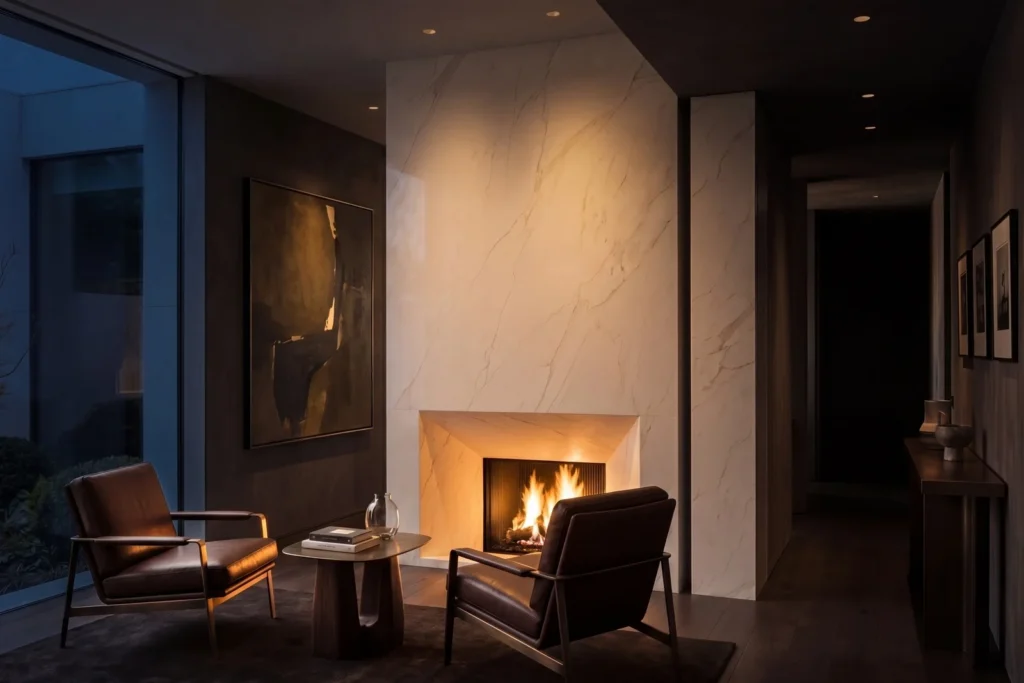 Material Study · 6 min
The Stone That Doesn’t Burn
Sintered stone is non-combustible by composition u2014 pure mineral, no resins, no organic content. A Material Study on the surface engineered for…
Material Study · 6 min
The Stone That Doesn’t Burn
Sintered stone is non-combustible by composition u2014 pure mineral, no resins, no organic content. A Material Study on the surface engineered for…